
Parity level
dRAID1, dRAID2 and dRAID3 tolerate one, two or three child-device failures per vdev respectively, while sufficient readable redundancy remains.
dRAID distributes data, parity and optional spare capacity across a larger disk population. It is a cost-conscious option when the requirement is one large storage system—not independent-node scale-out.
Supported euroNAS products: euroNAS Premium and euroNAS HA Cluster.
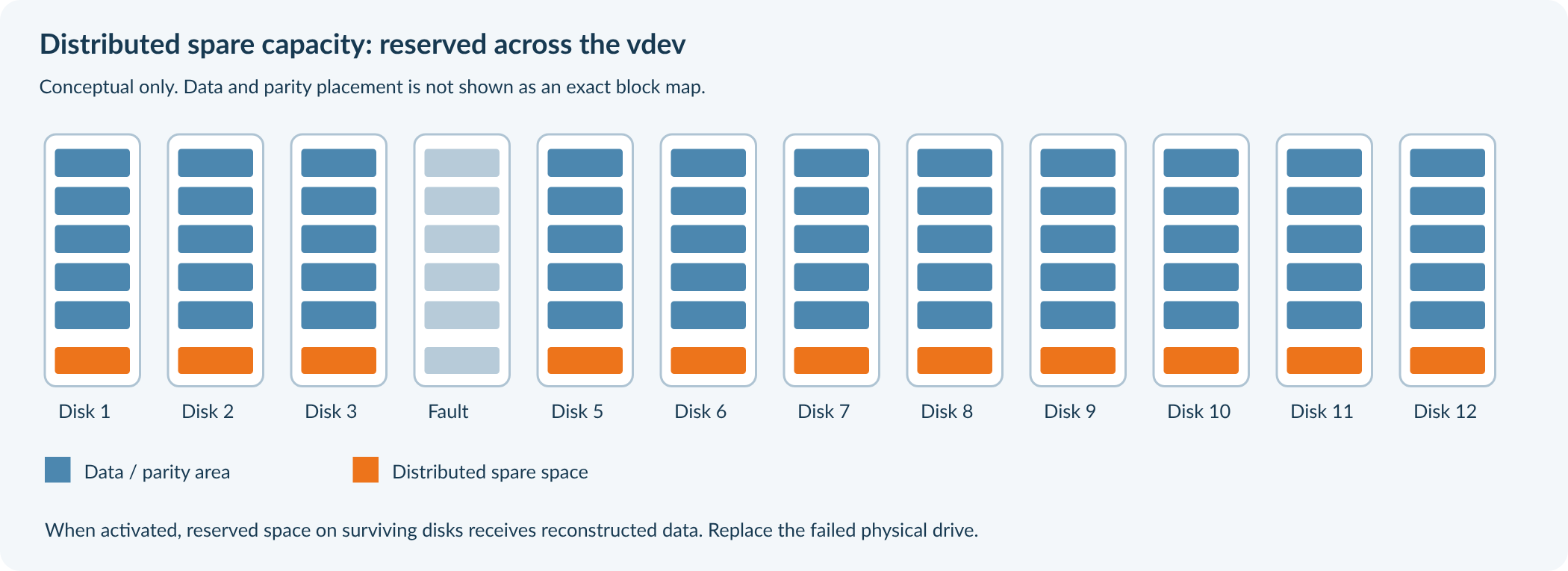
When recovery handling activates a distributed spare, surviving disks contribute reserved capacity and reconstruction work. A failed physical drive still has to be replaced.
dRAID1, dRAID2 and dRAID3 tolerate one, two or three child-device failures per vdev respectively, while sufficient readable redundancy remains.
Reserves disk-equivalents as a recovery destination across the vdev. It does not add another parity level.
Balance nominal capacity efficiency against allocation behaviour. Wider groups can waste more capacity for small blocks.
dRAID can be substantially simpler and more economical when the failure boundary and growth model fit one storage system. Scale-out remains the stronger choice when independent nodes, horizontal service growth or distributed site design are requirements.
| Question | Mirror / RAIDZ | dRAID | Scale-out storage |
|---|---|---|---|
| Primary model | One ZFS pool built from conventional vdevs. | One ZFS pool with a large distributed RAID vdev. | Data distributed across independent storage nodes. |
| Typical strength | Flexible vdev design; mirrors often suit random I/O. | High-capacity repositories and distributed reconstruction. | Horizontal capacity, performance and failure-domain growth. |
| Growth boundary | Within the server or shared-storage design. | Within the server or shared-storage design. | Add qualified nodes and redistribute data across the cluster. |
| Operational effort | Compact storage administration. | Compact storage administration with more geometry planning. | Cluster networking, node services and distributed operations. |
| Best economic fit | Small to medium pools or latency-sensitive layouts. | Large capacity in one system where scale-out is unnecessary. | Environments requiring node-level scale and distributed resilience. |
More disks do not automatically mean lower application latency. Representative testing should include block size, file size, compression, occupancy and simultaneous client activity.
The euroNAS wizard estimates geometry before metadata, allocation padding, reserved space and operational headroom. Actual application capacity is lower.
One server owns and operates the dRAID pool. This is the simplest model for a large-capacity storage repository where controller redundancy is not required.
Both controllers can access the shared disks, while exactly one owns the pool for read/write access. Cluster policies coordinate safe takeover and dependent services.
dRAID: reconstructs unavailable data within the selected parity tolerance.
Add HA: coordinated pool and service takeover requires HA Cluster.
Add replication: asynchronous transfer maintains a separate recovery copy.
Add recovery policy: snapshots, isolated backup and tested restoration remain essential.
Compare capacity, latency, recovery time, future growth and operational effort before choosing the geometry.