
Large Pools
ZFS uses Virtual Devices (VDEVs) as the underlying building blocks of a storage pool. The selected VDEV layout directly impacts performance, redundancy, usable capacity, and fault tolerance, allowing storage to be intelligently tuned for different workload requirements and deployment types.
Traditional RAID implementations are typically fixed at the controller level and often provide limited flexibility once deployed. ZFS VDEVs take a more intelligent software-defined approach, allowing storage layouts to be tuned around workload requirements rather than fixed hardware RAID constraints.
For example:
- Traditional RAID1 is broadly comparable to a ZFS Mirror VDEV
- RAID5 is conceptually similar to RAID-Z1
- RAID6 is conceptually similar to RAID-Z2
However, unlike traditional hardware RAID, ZFS combines the filesystem and volume manager together, allowing it to maintain end-to-end data integrity, detect silent corruption, and intelligently manage how data is distributed across the storage pool.
This approach also allows additional VDEV types such as metadata, cache, and log devices to be integrated directly into the storage architecture to further optimise performance and responsiveness for specific workloads.
Common VDEV types include:
- Stripe
Data is distributed across multiple disks for maximum performance and capacity utilisation. However, there is no redundancy and failure of a single disk will result in total pool failure. Typically used only for temporary, scratch, or non-critical workloads. - Mirror
Data is duplicated across two or more disks. This provides strong redundancy and fast read performance while allowing one or more disks to fail depending on the mirror width. Commonly used for virtualisation and performance-sensitive workloads. - RAID-Z1
Single parity protection similar in concept to RAID5. Provides protection against a single disk failure while offering improved usable capacity over mirrored layouts. Generally suited to smaller-capacity drives and lighter workloads. - RAID-Z2
Dual parity protection similar to RAID6. Allows two disks to fail without data loss and is one of the most commonly deployed enterprise ZFS layouts due to its balance between resilience and storage efficiency. - RAID-Z3
Triple parity protection allowing up to three simultaneous disk failures. Typically used in very large storage environments or archive platforms where maximum protection is required.
Additional specialised VDEVs can also be configured:
- Metadata VDEV (Special VDEV)
Dedicated devices used to store filesystem metadata separately from primary data. This can significantly improve performance for metadata-heavy workloads such as virtualisation, small file operations, and high IOPS environments. - Cache VDEV (L2ARC)
Optional read cache devices, typically SSD or NVMe based, used to extend the main memory cache and improve read performance for frequently accessed data. - Log VDEV (SLOG)
Dedicated intent log devices used to accelerate synchronous write operations. Commonly deployed in virtualisation and database environments where low latency writes are critical.
While ZFS provides extensive flexibility and tuning capability, euroNAS simplifies much of this complexity through guided pool creation workflows and sensible default recommendations, allowing administrators to deploy resilient storage platforms without requiring deep filesystem expertise.
The next section will walk through an abridged version of the pool creation process and demonstrate how these advances options are configured within euroNAS.
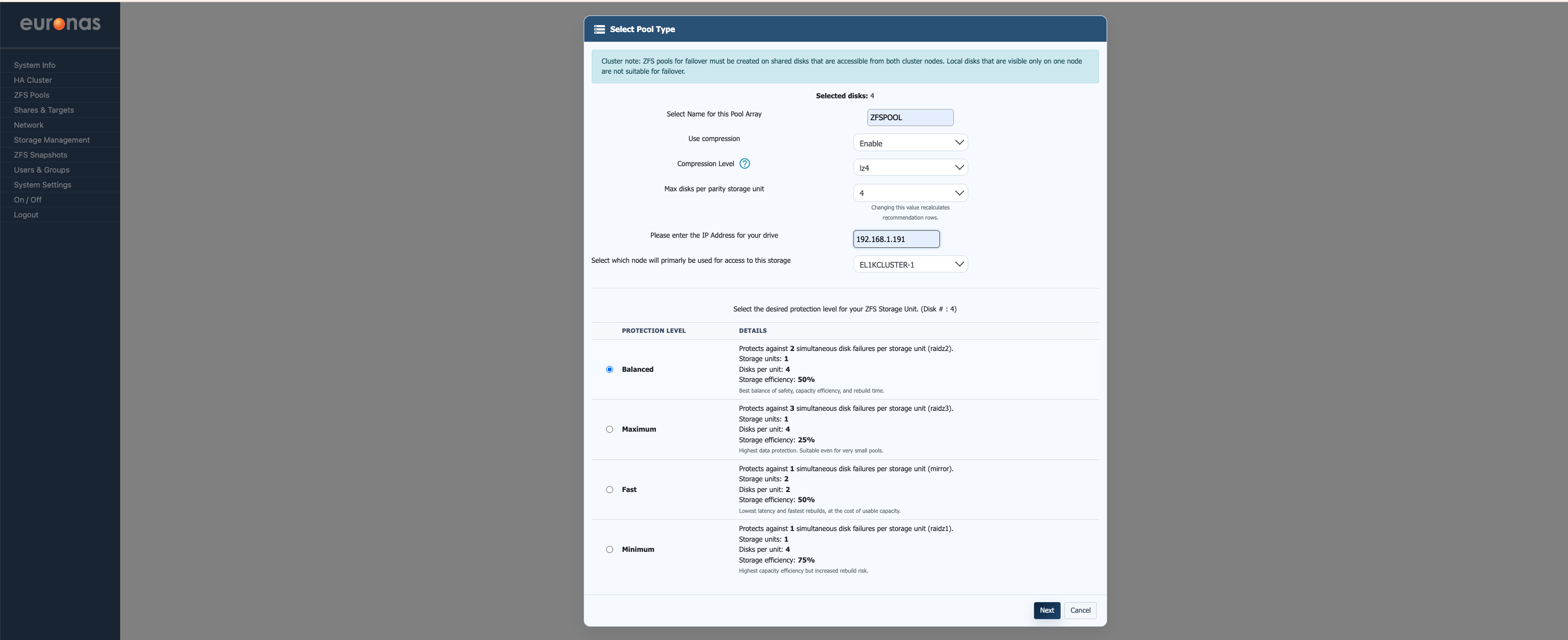
The Select Pool Type page allows euroNAS to intelligently recommend ZFS VDEV layouts based on the number of disks selected for the storage pool. Rather than requiring administrators to manually calculate optimal RAID groupings and parity layouts, euroNAS presents simplified protection profiles designed around common deployment requirements.
In this example four disks have been selected for the pool and the platform provides several recommended protection levels:
- Balanced
Configures the pool using a RAID-Z2 style layout, providing protection against two simultaneous disk failures while maintaining a balance between resilience, usable capacity, and rebuild performance. This is generally recommended for most production environments. - Maximum
Prioritises maximum fault tolerance using a RAID-Z3 style configuration capable of surviving three simultaneous disk failures. This option provides the highest level of protection but reduces usable storage capacity. - Fast
Uses a mirrored layout focused on performance and rebuild speed. This configuration provides lower latency and strong resilience characteristics but with reduced storage efficiency. - Minimum
Uses a RAID-Z1 style configuration which maximises usable capacity while still providing protection against a single disk failure. This option offers improved storage efficiency but lower fault tolerance compared to RAID-Z2 or mirrored configurations.
The Max disks per parity storage unit option allows further tuning of how disks are grouped within the underlying VDEV structure, enabling administrators to optimise layouts for larger pools and different workload profiles.
This abstraction layer allows euroNAS to simplify much of the complexity traditionally associated with ZFS VDEV design while still exposing the flexibility and intelligence of the underlying filesystem architecture.