
eEVOS Off-Site Disaster Recovery
Use Off-Site VM Disaster Recovery isto a critical feature in eEVOS that provides protection against catastrophic failures, whether caused by hardware issues, data corruption, or natural disasters. By replicatingcopy virtual machines (VMs) to a remote site, eEVOS ensures that your data and applications can be quickly recovered, minimizing downtime and ensuring business continuity.
1. Asynchronous VM Replication
eEVOS enables you to replicate VMs asynchronously tofrom a remote eEVOS installation to this system. You can run copies on a schedule or keep selected VMs synchronized continuously so that they are available after a site failure.
Start a recovered VM only after you have confirmed that the source VM is shut down or isolated. Running the same VM at both sites can cause duplicate IP addresses, conflicting services, and application data corruption.
What the DR service does
- Connects this recovery system to one or more remote eEVOS installations.
- Copies the selected VMs to a local target drive.
- Runs according to a schedule or maintains a recent asynchronous copy.
- Shows the state of every protected VM in the DR overview.
- Allows an administrator to start a recovered VM when the source site is unavailable.
Off-site replication complements backups; it does not replace them. Keep separate, retention-based backups for deleted files, logical corruption, and ransomware recovery.
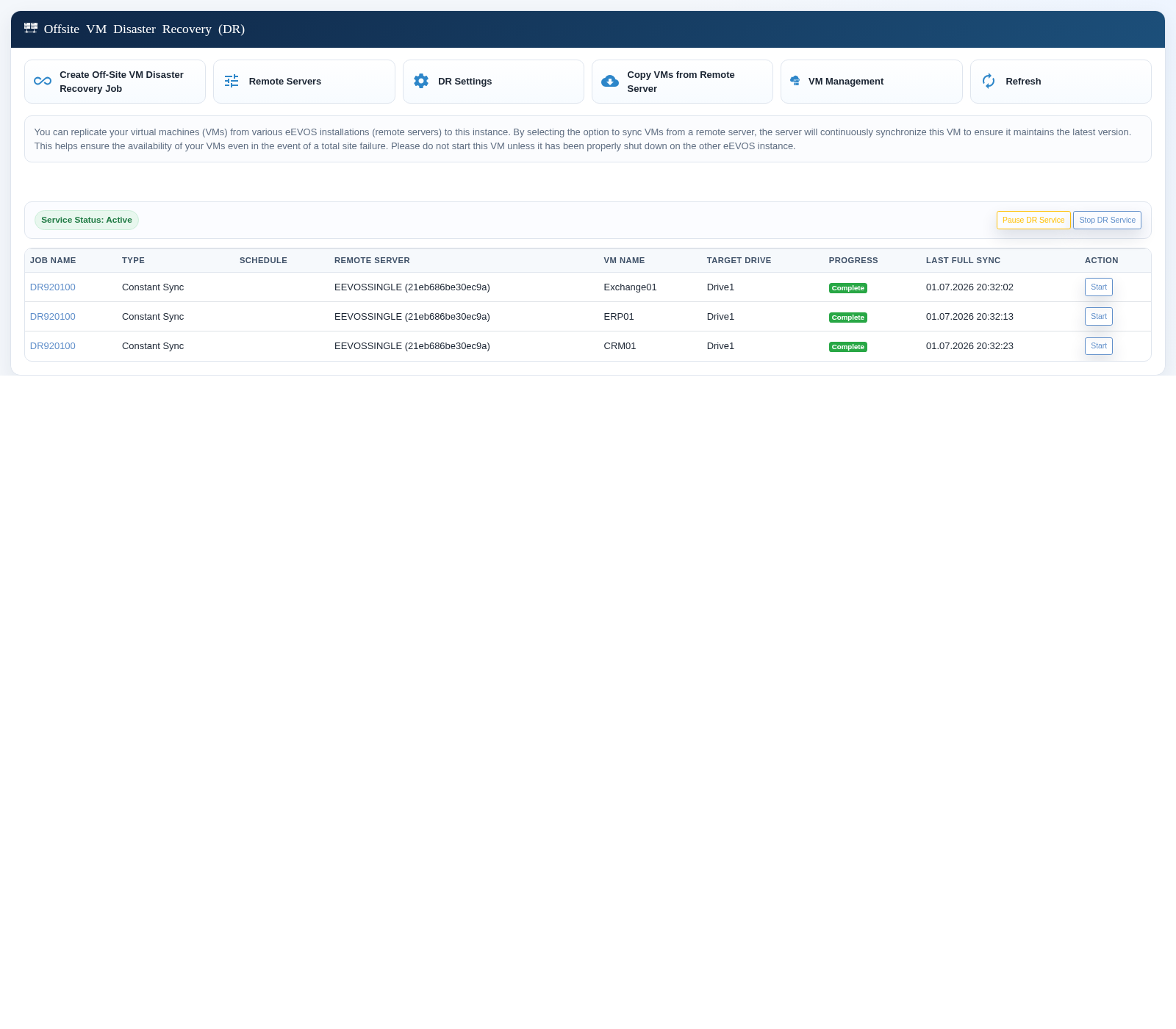
Open the DR overview
- Sign in to the eEVOS system that will hold the recovery copies.
- Open Offsite VM Disaster Recovery (DR).
- Confirm that Service Status is active.
- Review existing jobs, their remote server, VM, target drive, progress, and last full synchronization.
Create a DR job
- Select Create Off-Site VM Disaster Recovery Job.
- Choose one of the two replication types.
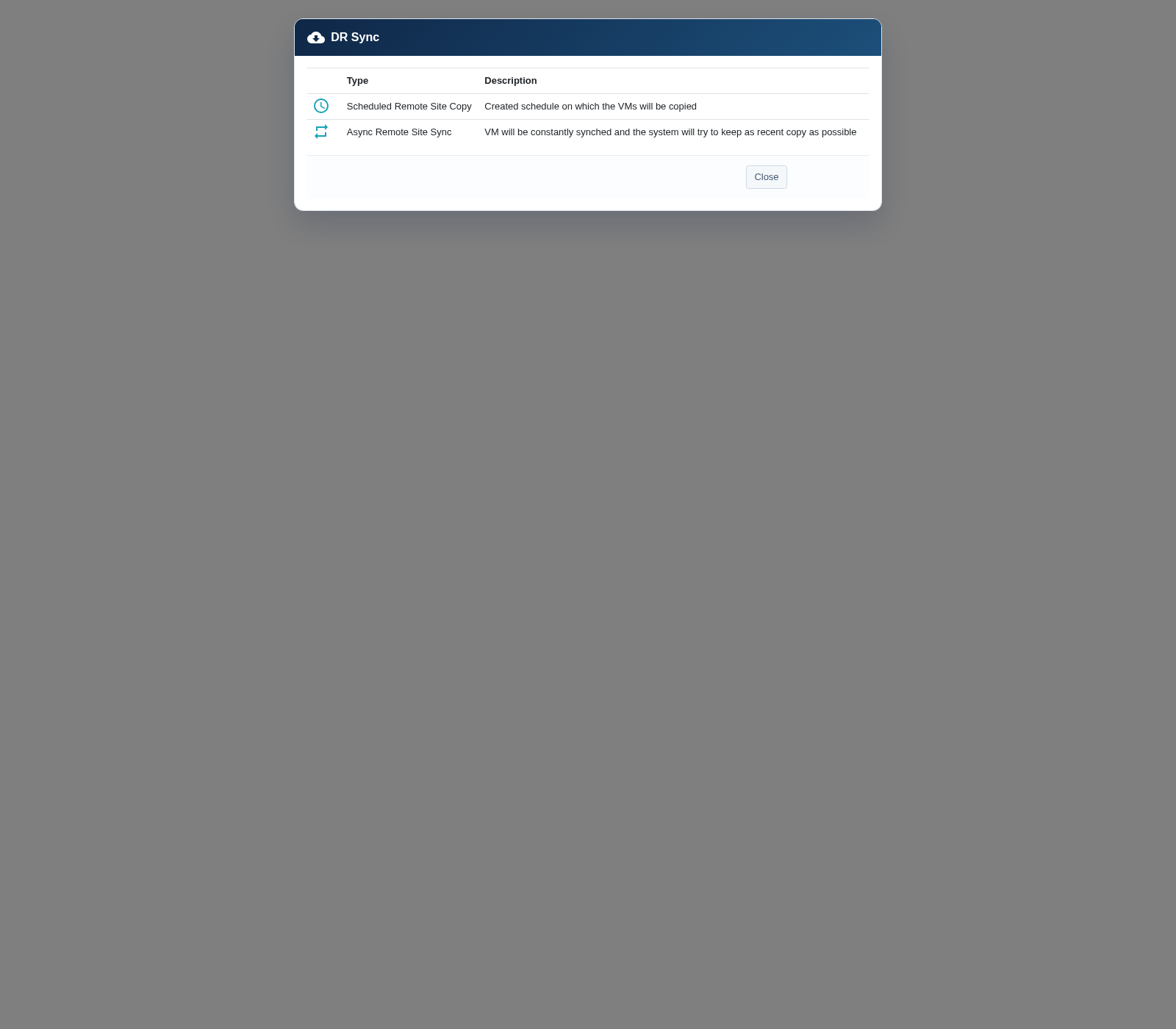
| Type | How it works | Choose it when |
|---|---|---|
| Scheduled Remote Site Copy | Copies the selected VMs on chosen weekdays and at a defined start time. | A predictable copy window and controlled bandwidth use are more important than the shortest recovery point. |
| Async Remote Site Sync | Continuously attempts to keep the recovery copy as recent as possible. | You need a shorter recovery point and have sufficient bandwidth and target capacity. |
Configure a scheduled copy
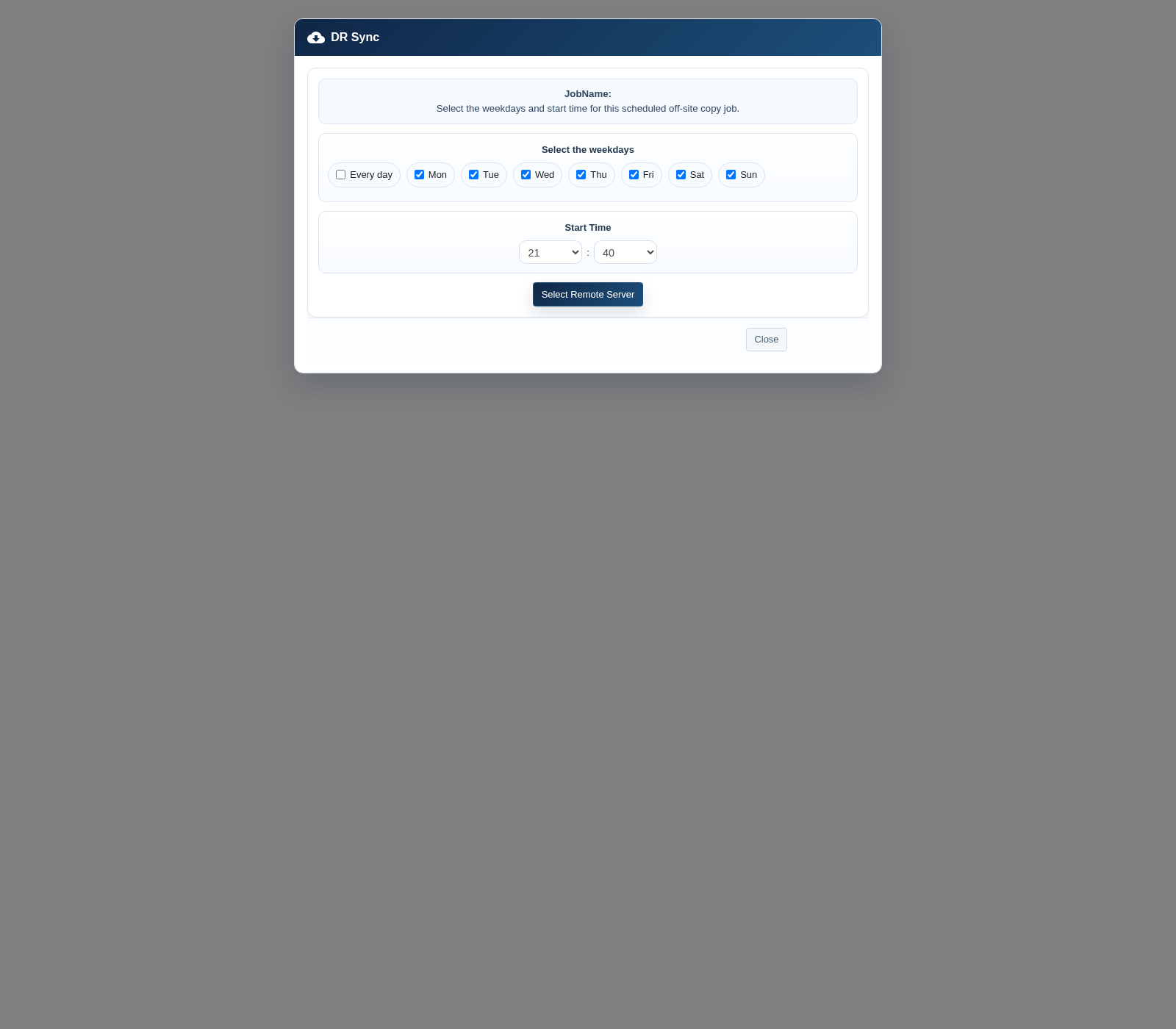
- Select Scheduled Remote Site Copy.
- Enter a clear job name.
- Select the weekdays on which the job should run.
- Set the start time. Choose a window that does not overlap with heavy production or backup activity.
- Select Select Remote Server.
Configure asynchronous synchronization
- Select Async Remote Site Sync.
- Choose the remote eEVOS installation that contains the source VMs.
- Continue to VM and target-drive selection.
Asynchronous synchronization minimizes the age of the recovery copy, but replication delay still depends on change rate, network throughput, storage performance, and interruptions. Treat the displayed last synchronization time as the current recovery point.
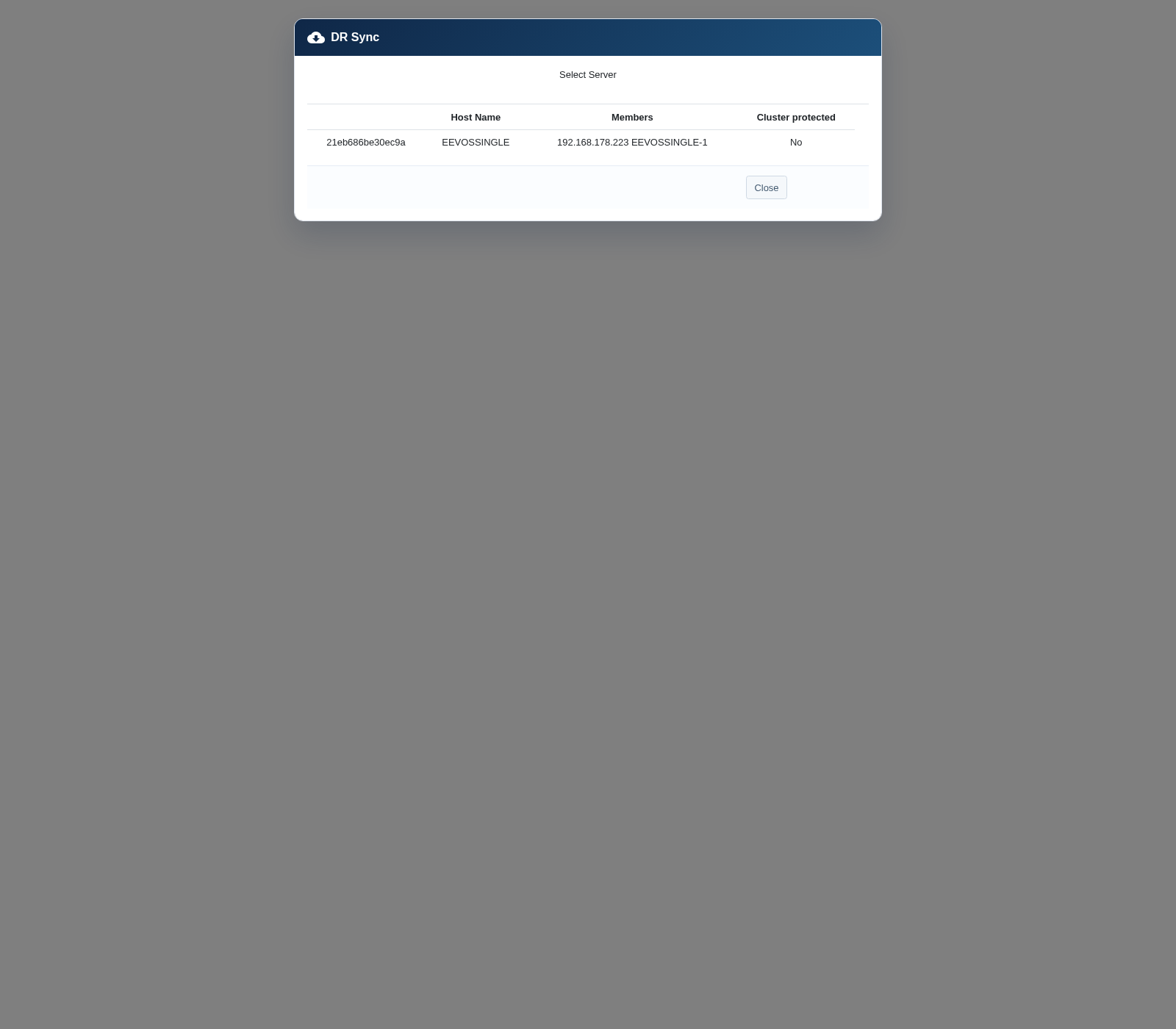
Select the remote installation
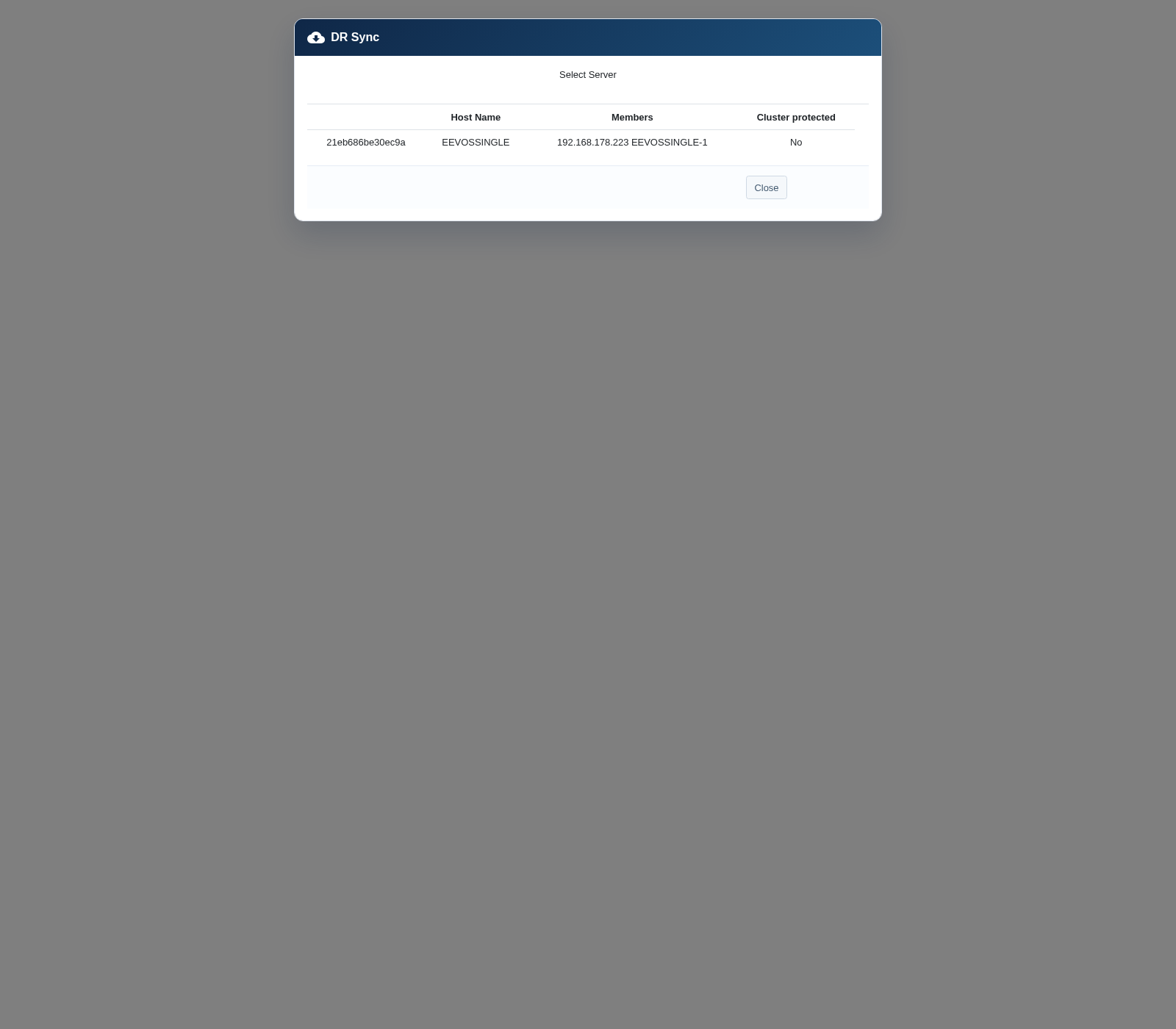
The server list shows the configured remote installations, their members, and whether they are cluster-protected.
- Verify the host name and member addresses.
- Select the intended remote installation.
- If it is missing, close the wizard and configure it under Remote Servers first.
Select VMs and recovery targets
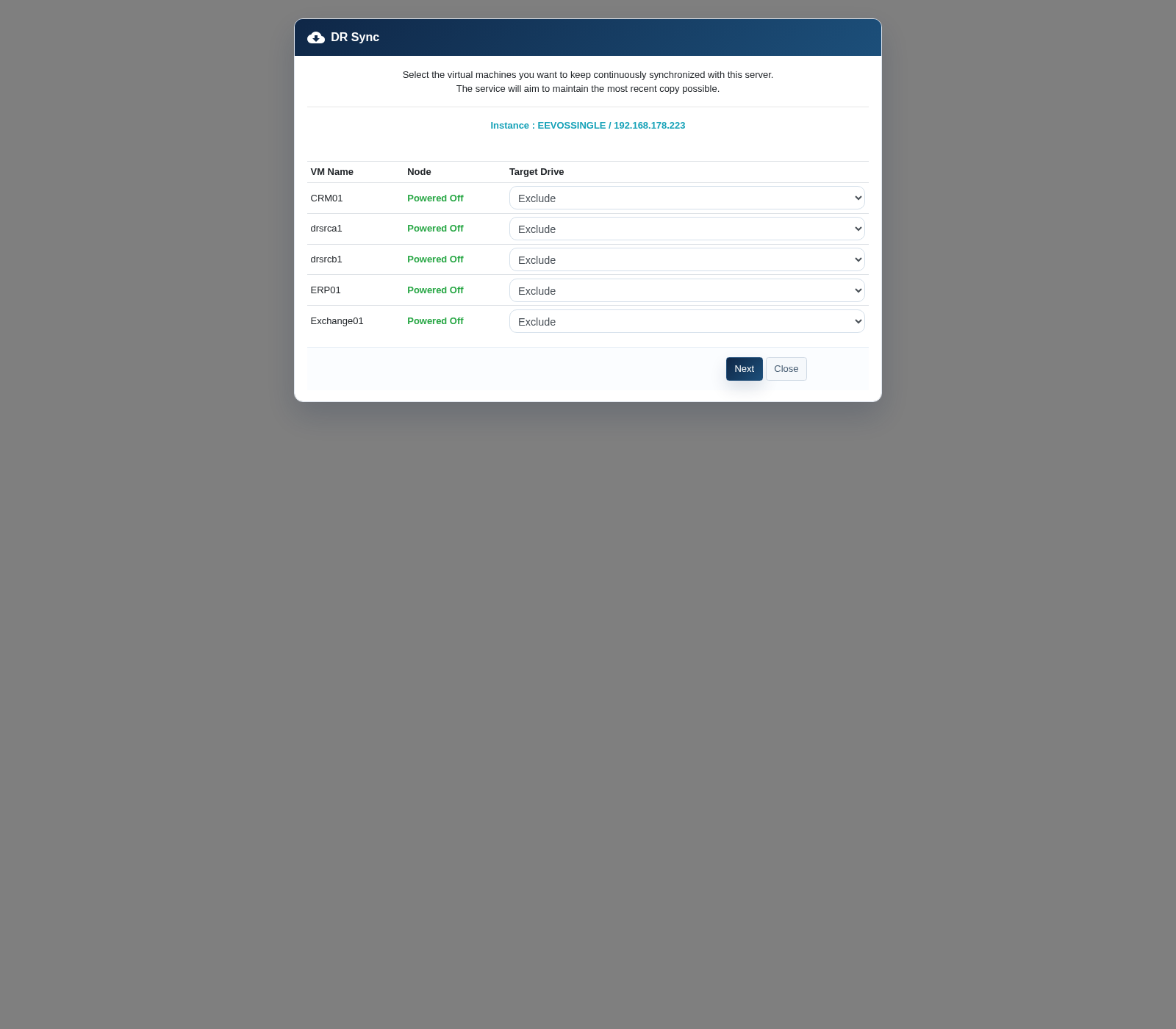
The wizard lists the VMs available on the selected remote installation.
- For each VM you want to protect, select the local target drive.
- Leave VMs that should not be copied set to Exclude.
- Ensure that the target drive has enough capacity for the VM, its changes, and operational reserve.
- Select Next, review the summary, and create the job.
Monitor the DR job
Return to the DR overview and use Refresh to update the status.
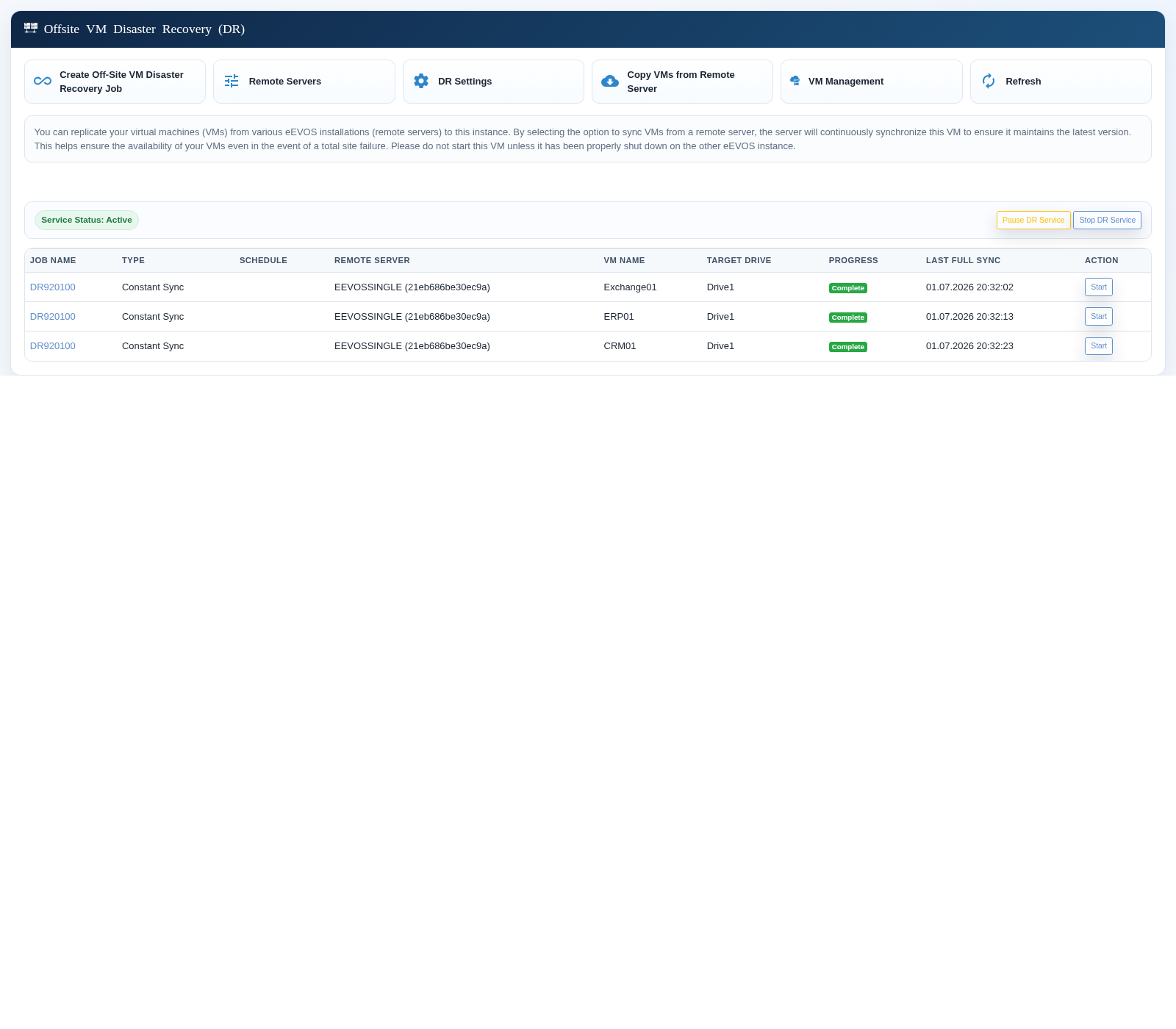
| Field | How to use it |
|---|---|
| Type | Confirms whether the VM uses a scheduled copy or continuous synchronization. |
| Remote Server | Identifies the source installation. |
| Target Drive | Shows where the recovery copy is stored. |
| Progress | Shows the current copy cycle. Complete means that |
| Last Full Sync | Indicates the |
Investigate failed, stalled, or increasingly delayed jobs. Check network connectivity, remote-server credentials, free capacity, VM state, and system is running, changes to the VMs are periodically synced to the off-site location, ensuring that your backup is always up to date.logs.
DataaProtection:VMAsynchronous replication ensures that even if the primary system experiences an issue, the replicated data onat the remote siteremains- Confirm that the production VM and
readyits source network are shut down or isolated. - Check the job status and last successful synchronization time.
- Verify that the recovery site's virtual networks and storage are available.
- Select Start for
recovery.
intact- Confirm that the production VM and
ReducedConnectLatency:itUnliketosynchronousanreplication,isolatedasynchronousrecovery network first when your runbook requires validation before production access.- Verify boot, application consistency, IP configuration, DNS, dependencies, and user access.
- Document the recovery point and the services started at the recovery site.
- Review all DR jobs daily and investigate missed schedules or delayed synchronization.
- Monitor free space on every target drive.
- Test recovery regularly without connecting duplicate services to the production network.
- After application or network changes, update the recovery runbook.
- Protect remote-server credentials and limit DR administration to authorized users.
- Keep enough compute, memory, storage, and network capacity at the recovery site for the VMs you intend to start.
Disaster Recovery Readiness:In the event of a disaster, the off-site copy of your VMsdata can bequickly brought online, ensuring that your services remain available.
Recover
Operational checks
Choosing the replication doestype
Use requirescheduled thecopies for systems towhose wait for every change to be confirmed by the remote site, allowing for better performance.
2. Scheduled Replication
eEVOS provides the flexibilityrecovered to schedulea defined daily or weekly point and where replication jobstraffic basedmust onstay your needs. You can define how frequently the VMs are replicated to the remote site, whether onwithin a daily,fixed hourly,window. orUse customasynchronous schedule.
Customizable Backup Strategy:Set replication schedules to fit your business needs, balancing data currency with system performance.Automated Backups:eEVOS automatically manages the replication process, ensuring that your disaster recovery site is always prepared without manual intervention.Granular Control:You can select individual VMssynchronization forreplication or replicate entire clusters, providing flexibility in your disaster recovery planning.
3. Full VM Recovery
In case of a critical failure or disaster, eEVOS allows you to fully restore VMs from the off-site disaster recovery location. This ensures that your VMs, along with their data, configurations, and applications, are ready to be brought back online as soon as needed.
Seamless Recovery:Replicated VMs can be restored in full to ensure the fastest possible recovery with minimal configuration required.Entire VM Recovery:Bring back the complete virtual environment, including system settings, to quickly restore operations.Business Continuity:With off-site disaster recovery, you can continue operations in a different location, reducing the impact of the disaster.
5. Simplified Setup and Management
Setting up Off-Site Disaster Recovery in eEVOS is straightforward, with an intuitive interface that allows you to easily configure replication schedules and select which VMs or clusters to replicate.
User-Friendly Interface:eEVOS provides a simple setup wizard to configure off-site replication with minimal effort.Centralized Management:Manage replication tasks and monitor the status of off-site backups from a central dashboard.Scalability:eEVOS disaster recovery is scalable to your needs, whether you’re managing a fewbusiness-critical VMsorthat need alargemoreinfrastructurerecentwithcopy.multipleAclusters.mixed
Conclusion
The Off-Site Disaster Recovery feature in eEVOSapproach is anoften essentialappropriate: toolcontinuous synchronization for businesses seeking to ensure the highestmost levelscritical of data protectionservices and availability. With asynchronous replication, scheduled backups,copies fullfor VMless andtime-sensitive file-level recovery, and an easy-to-use interface, eEVOS provides a comprehensive solution that protects your infrastructure from data loss and ensures fast recovery in any disaster scenario.workloads.