
Build and operate your own branded S3 service
Combine private scale-out object storage with customer management, usage collection, billing exports and a customisable end-user S3 File Manager—on infrastructure and service terms you control.
Operate S3 as a customer-facing service
An MSP needs more than an S3 endpoint. Customers must be separated, usage must be measurable, credentials and quotas must be manageable, and the user experience should carry the provider’s identity.
eEKAS is used here as an implementation example because its S3 service layer combines these commercial and operational functions with distributed Ceph storage.
A complete service loop
1
2
3
4
MSP recommendation: use eEKAS exclusively for customer-facing S3 services.
eEKAS combines Ceph scale-out storage with customer management, usage and billing workflows, fine-grained service controls and the customisable end-user S3 File Manager required for a commercial multi-customer offering.
Not every euroNAS S3 implementation targets an MSP model
All three platforms include an S3 File Manager. eEKAS adds the quota and billing capabilities required for a commercial multi-customer offering.
| Platform | Architecture | Quota options | S3 File Manager | Billing functions | MSP suitability |
|---|---|---|---|---|---|
| euroNAS Premium | Single-server Storage OS | Bucket-count quota | Included | Not included | Not recommended for commercial multi-customer S3 services |
| euroNAS HA Cluster | High-availability storage pair | Bucket-count quota | Included | Not included | Not recommended for commercial multi-customer S3 services |
| eEKAS | Ceph-based distributed scale-out cluster | Storage-capacity and bucket-count quotas | Included | Usage collection and billing export | Recommended MSP platform |
The S3 File Manager is available with all three platforms. Premium and HA Cluster can restrict the number of buckets, but do not assign a storage-capacity quota or provide billing functions. eEKAS supports both quota types as well as usage collection and billing export, making it the appropriate basis for commercial multi-customer S3 services.
One operating model from customer to capacity
Customer management
Create customer records, assigned users, buckets and per-customer capacity boundaries.
Usage and billing data
Collect usage for defined periods and export customer or user summaries for downstream invoicing.
Custom branding
Apply a provider-specific title, colours, logo, login text and external service address.
End-user File Manager
Give customers a separate browser application for buckets and objects—not access to the admin console.
Retention services
Offer versioning, lifecycle and Object Lock/WORM as policy-based service options.
Scale-out foundation
Grow capacity across standard x86 storage nodes without tying the service to one appliance model.
Keep administration, customer access and storage clearly separated
Customers should never need access to the storage administration interface. They use the branded File Manager or standard S3 tools, while the provider controls service policy and infrastructure.
Administrative service console
Used by the MSP to create customers, manage credentials, define quotas, configure protection and collect usage.
Branded S3 File Manager
A separate application with its own login. Customers can create and manage permitted buckets, upload and organise files, work with versions and use sharing functions.
Turn measured consumption into invoice-ready data
The service console can collect S3 usage for a selected period and calculate amounts from defined price-per-GB and minimum-charge values. Providers can review usage by customer, user or bucket and export billing or user-summary CSV files.
- Customer ID, name, contact and service assignment
- Quota, consumed capacity, object count and bucket breakdown
- Price per GB and optional minimum charge
- Period-based collection and billable-only filtering
- CSV export for accounting or billing workflows
The integrated function provides usage collection, calculation and export. It does not replace a full accounting, taxation, CRM or payment platform.
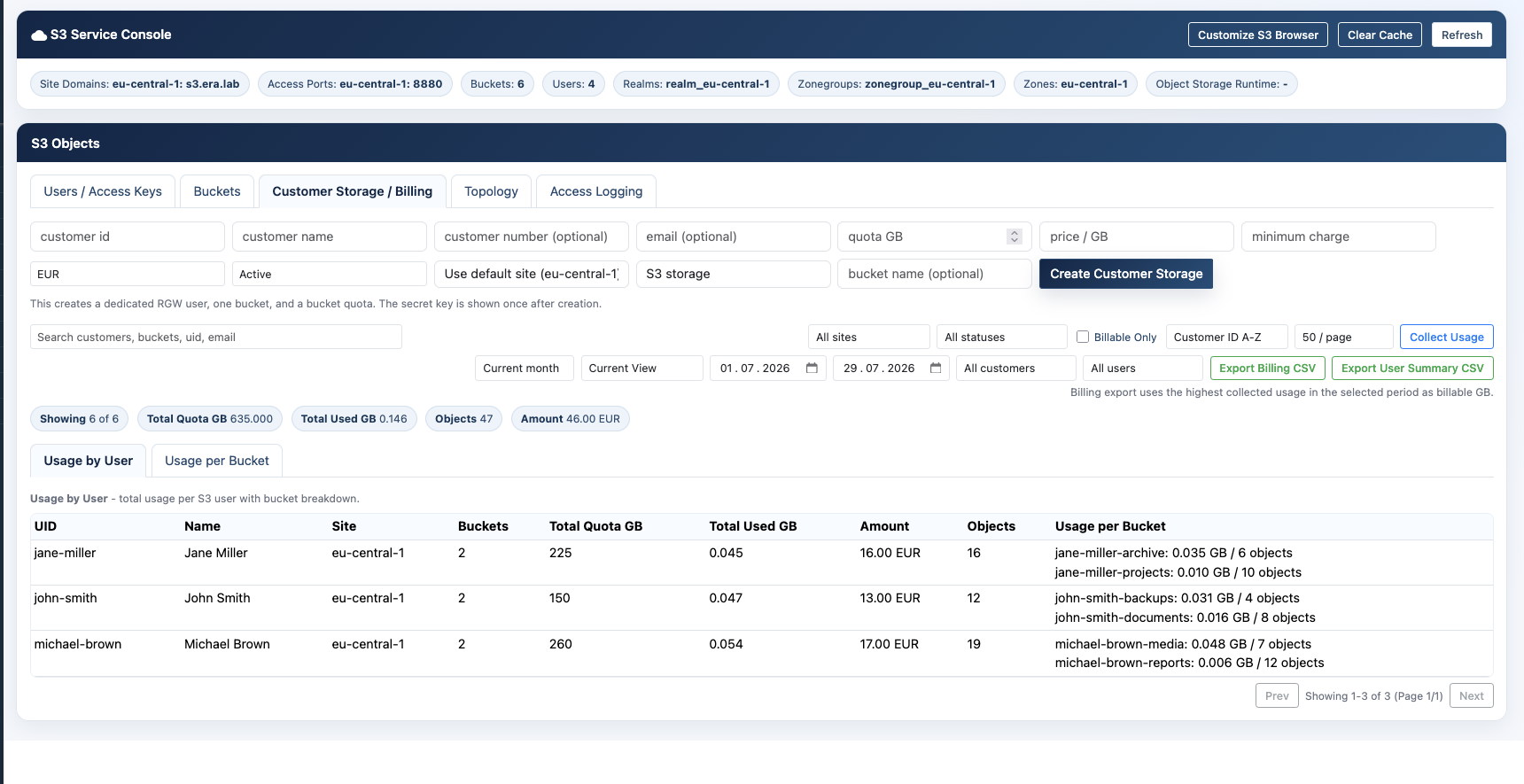 Customer Storage and BillingReview quotas, used capacity, calculated amounts and usage by bucket.
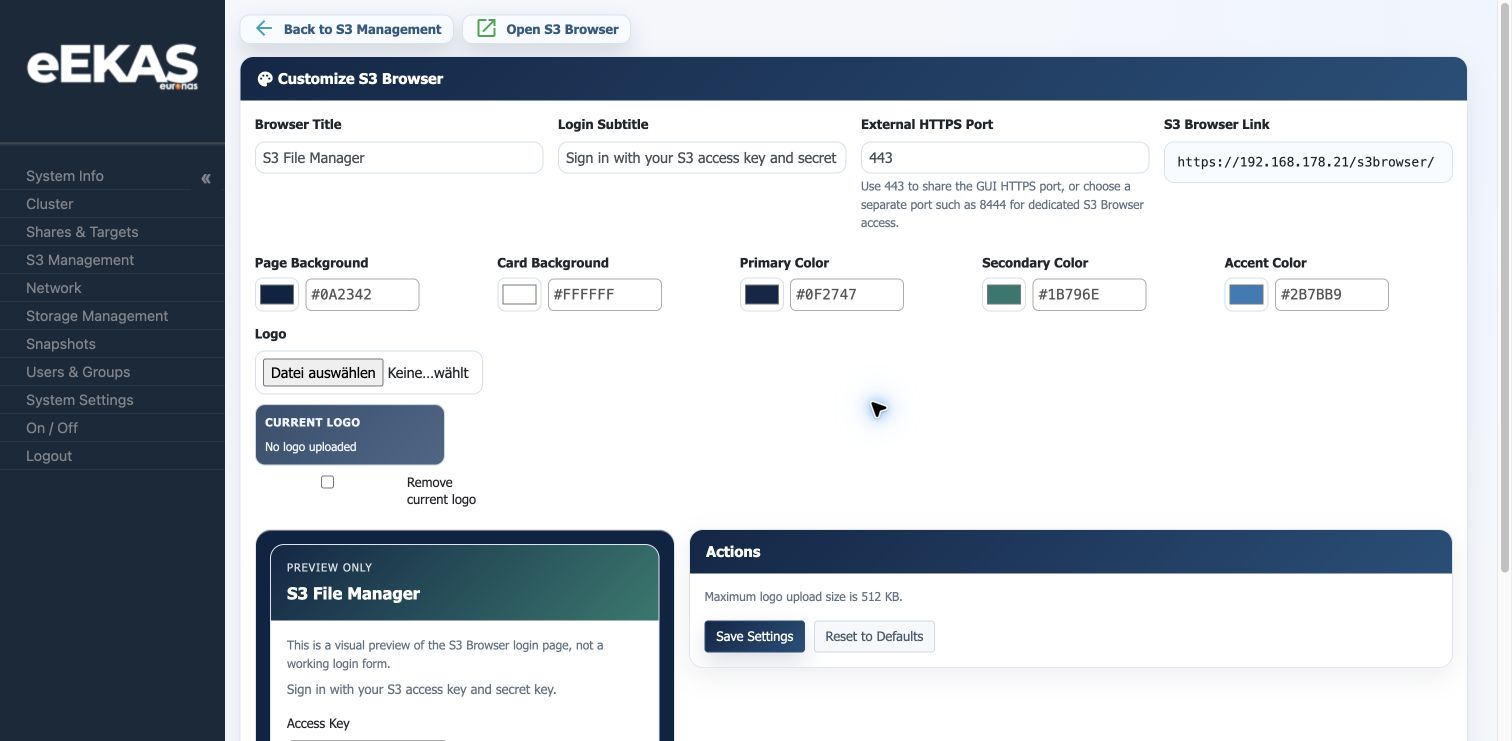 Customise the customer experiencePreview colours, logo, title, login text and the external HTTPS service address.
Present the service under your own identity
The end-user S3 File Manager can be adapted to the provider’s brand. It remains separate from the eEKAS administrative console and gives customers a direct login for their own S3 credentials.
Create service tiers around policy—not only capacity
The following examples illustrate how MSPs can combine capacity, protection and location into understandable offers.
Standard
- Defined capacity quota
- S3 API and File Manager
- Access logging
- Replicated or erasure-coded storage profile
Protected
- Versioning enabled
- Object Lock/WORM option
- Lifecycle policy
- Longer log retention
Multi-site
- Geographically separate site
- Defined replication policy
- Documented recovery workflow
- Higher availability objective
Design for both normal service and recovery
Within a site
- Load-balanced S3 gateways
- Redundant client and cluster networks
- Replication or erasure coding across failure domains
- Capacity headroom for recovery and rebalancing
Across sites
- Multi-zone or multi-site topology
- Bandwidth and latency qualification
- Defined consistency and failover behaviour
- Tested recovery and return-to-service procedures
A commercial SLA must reflect the qualified architecture.
Distributed redundancy, versioning and WORM address different risks. None of them alone defines backup, disaster recovery or a guaranteed service level.
Customer onboarding and separate end-user access
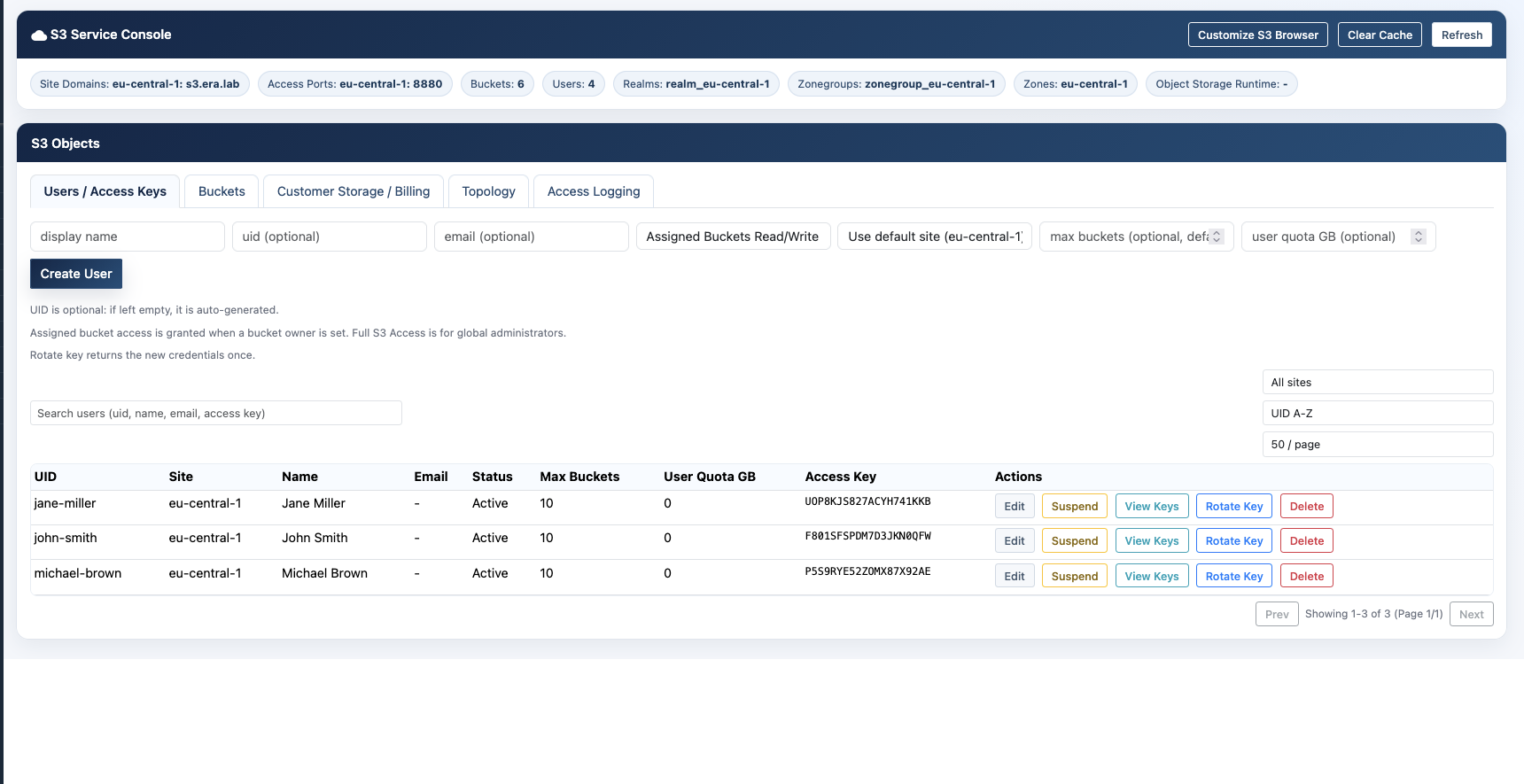 Users and access keysCreate users, assign buckets, define quotas and rotate credentials.
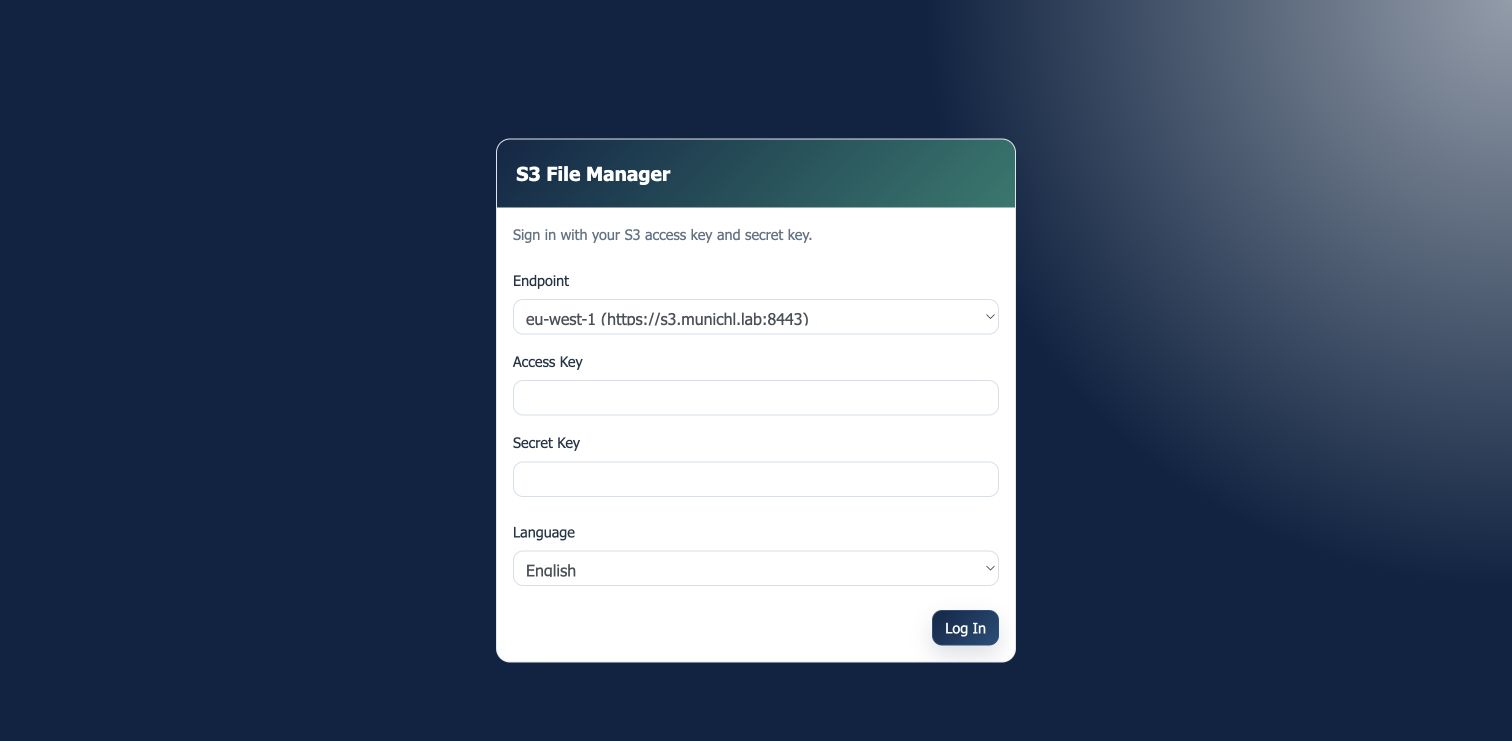 Separate customer loginCustomers authenticate to the File Manager rather than the administrative console.
Define the service before building the cluster
Customer count, object growth, retention, billing model, brand, site topology and recovery commitments shape the right platform.
This page describes a service-delivery pattern using eEKAS as the implementation example. Usage exports support downstream billing workflows but do not replace accounting, taxation, CRM or payment systems. S3 compatibility does not imply an affiliation with Amazon Web Services; Wasabi is referenced only as a familiar market example.